


A freshly laid asphalt surface can look finished before it has achieved the density and durability a project requires.
The final rolling passes are critical. The right Dynapac Double Drum Roller can help contractors achieve consistent compaction, a smoother finish and efficient coverage while the asphalt remains within its workable temperature range.
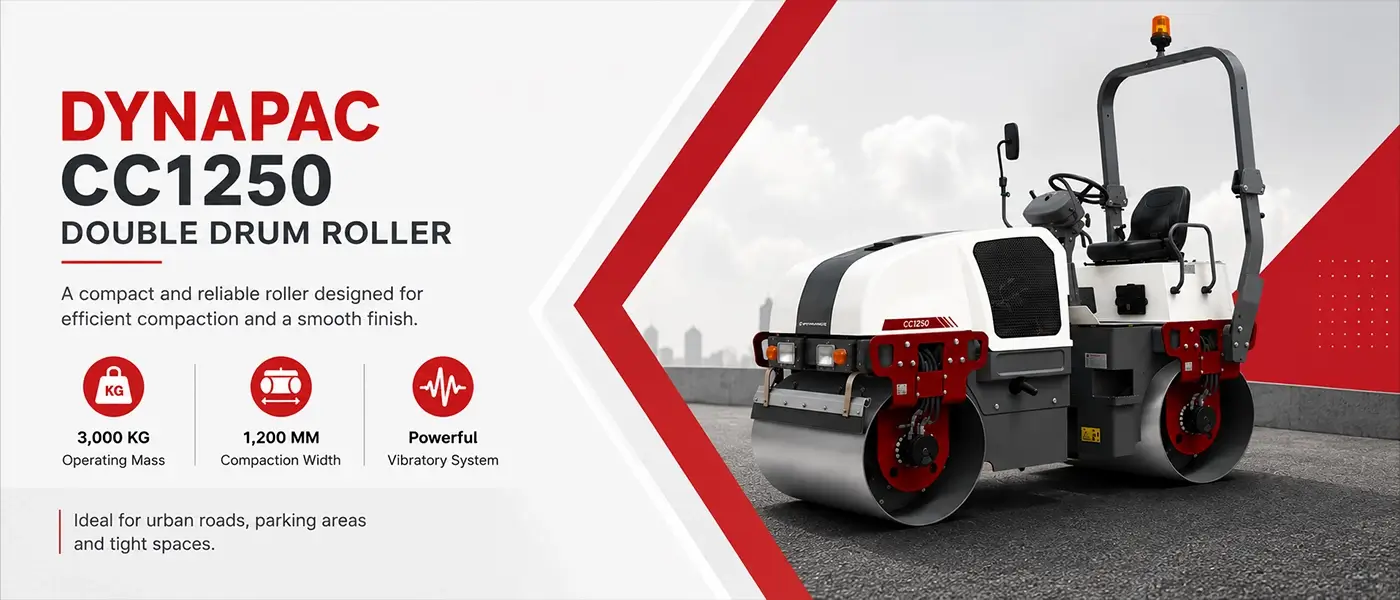
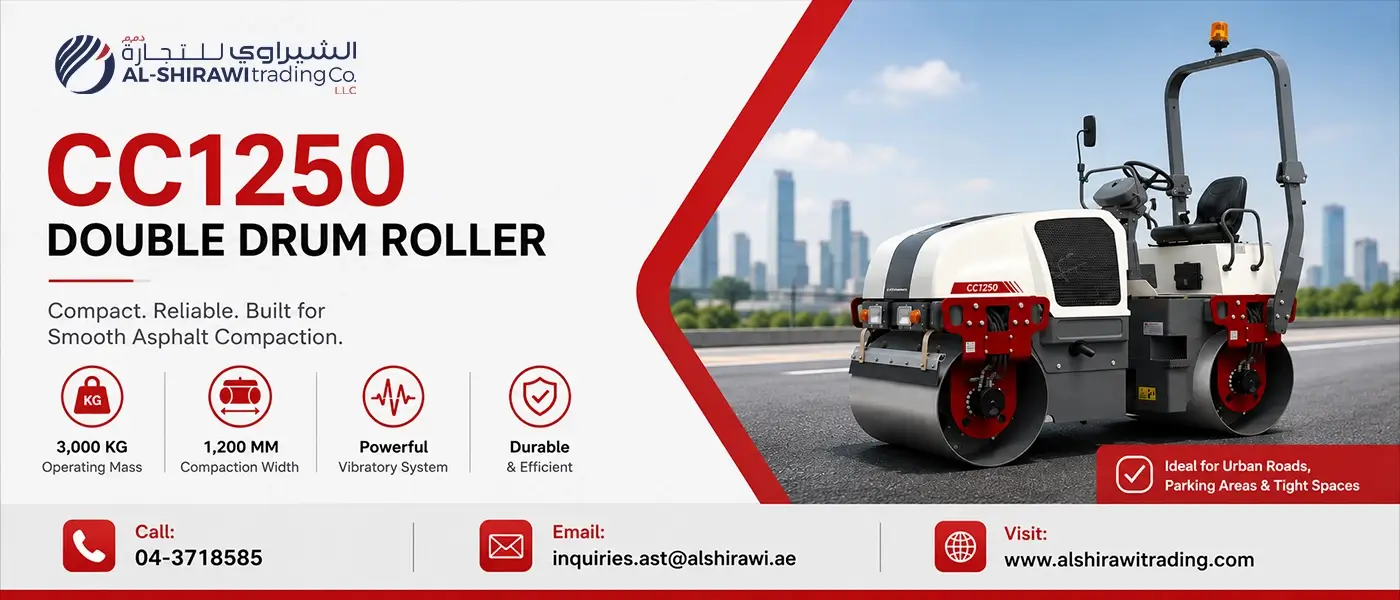
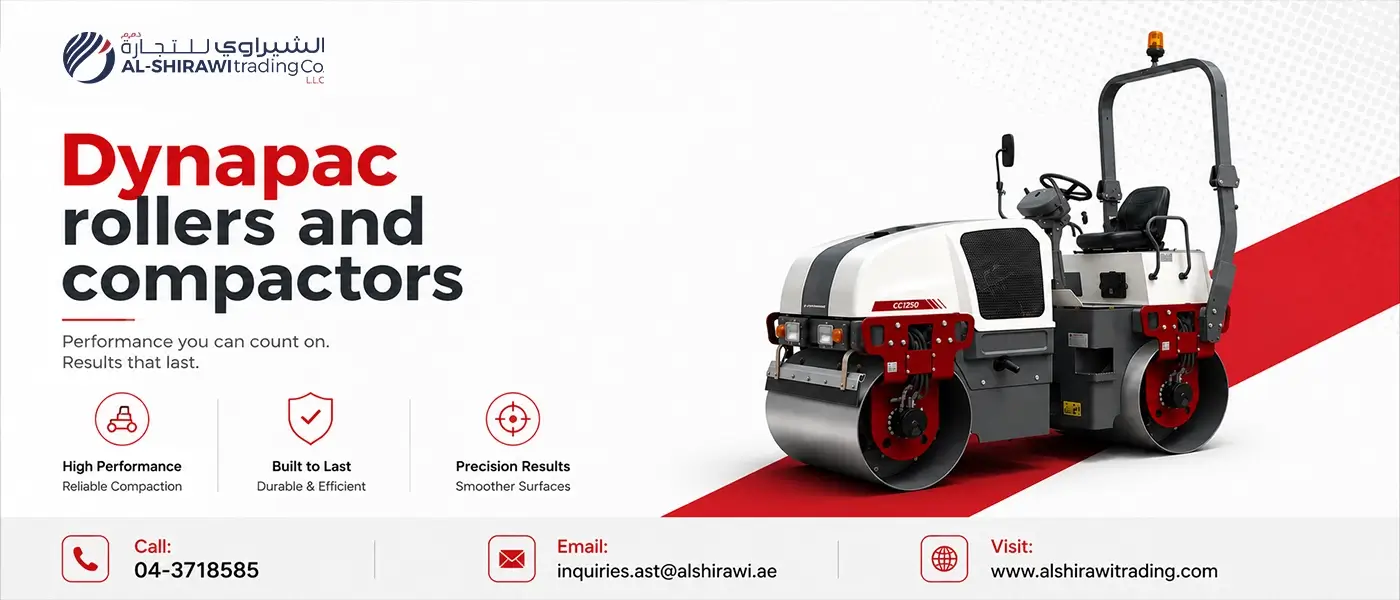
For urban roads, parking areas and other applications where manoeuvrability matters, the Dynapac CC1250 offers a compact tandem-roller solution. With a 3,000 kg operating mass, 1,200 mm compaction width and double-drum vibratory configuration, it is designed for controlled asphalt compaction and finishing.
Why the final passes matter
Asphalt compaction is about more than appearance.
Compaction reduces air voids within the asphalt mixture and increases its density. Achieving the required density helps the finished pavement withstand traffic and environmental stresses more effectively.
The challenge is timing. Asphalt becomes progressively less workable as it cools, so the roller needs to achieve the required result efficiently rather than simply making as many passes as possible.
A good finishing operation balances:
- Asphalt temperature
- Rolling speed
- Number of passes
- Vibration settings
- Layer thickness
- Required density
- Surface smoothness
The roller is therefore an important part of the entire paving process, not simply the machine used at the end.
Why choose a double drum vibratory roller?
A tandem roller uses both front and rear drums for compaction. This makes the configuration particularly suitable for asphalt applications where consistent contact and surface finishing are important.
The Dynapac CC1250 combines double-drum vibration with a compact design, making it suitable for projects where contractors need controlled compaction without the footprint of a larger road roller.
Its specifications include:
Specification | Dynapac CC1250 |
Operating mass | 3,000 kg |
Maximum operating mass | 3,100 kg |
Compaction width | 1,200 mm |
Drum diameter | 682 mm |
Speed range | 0–13 km/h |
Rated power | 26.1 kW / 35 hp |
What makes the Dynapac CC1250 suited to finishing work?
The CC1250’s value is not simply its operating weight. Its combination of size, drum width, vibration and manoeuvrability makes it useful where precise asphalt compaction is required.
1. Compact size for restricted sites
With a 1,200 mm compaction width and a listed outside turning radius of 4,100 mm, the Dynapac CC1250 can be practical for urban streets, parking areas and other locations where working space is restricted.
A smaller roller can also make it easier for operators to position the machine around kerbs, intersections and other obstacles.
2. Controlled vibratory compaction
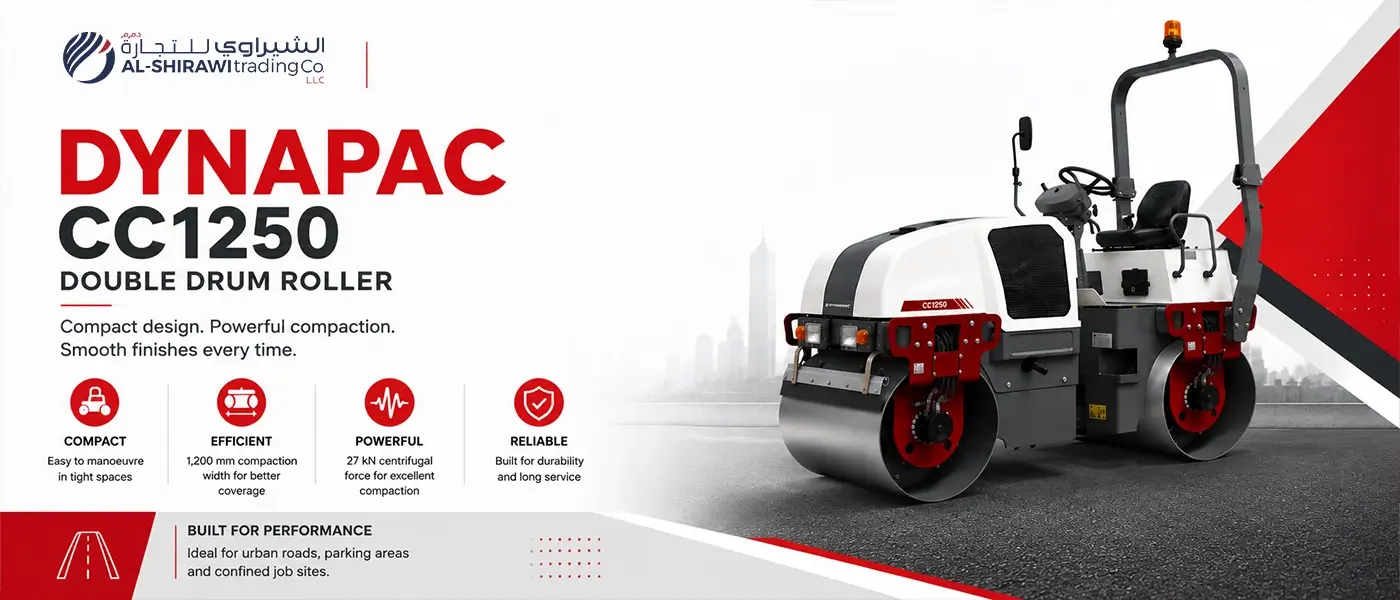
Dynapac lists a nominal amplitude of 0.5 mm, a vibration frequency of 58 Hz and centrifugal force of 27 kN for this double drum roller. Providing the right vibratory compaction capability needed for asphalt applications. Correct operating settings should always be selected according to the asphalt mix, temperature and project requirements.
3. Efficient coverage
A roller’s productivity is not determined by speed alone.
The operator needs to maintain a consistent rolling pattern, appropriate speed and correct overlap between passes. The Dynapac CC1250’s compact dimensions can help make that process manageable on smaller or more confined paving areas.
Smoothness is important, but density comes first
One common mistake is to judge compaction solely by how the asphalt looks.
A smooth surface does not automatically mean the required density has been achieved.
The rolling operation should be based on the project’s specifications and the recommendations for the particular asphalt mixture. Operators should consider the material temperature, layer thickness, rolling sequence and required number of passes.
A practical approach is to establish the rolling pattern before production begins and monitor the mat throughout the operation.
Keep these factors under control
Temperature: Compaction needs to happen while the asphalt remains workable.
Speed: The maximum travel speed of the machine is not necessarily the appropriate speed for every pass.
Passes: More passes do not automatically produce better results. The target is the required density without unnecessary rolling.
Overlap: Consistent overlap helps avoid areas receiving insufficient or excessive compaction.
Edges and joints: These areas require deliberate positioning and rolling techniques to achieve a uniform result.
The best roller operator is not simply the one who completes the most passes. It is the one who consistently achieves the required result.
Is a 3 ton double drum roller right for your project?
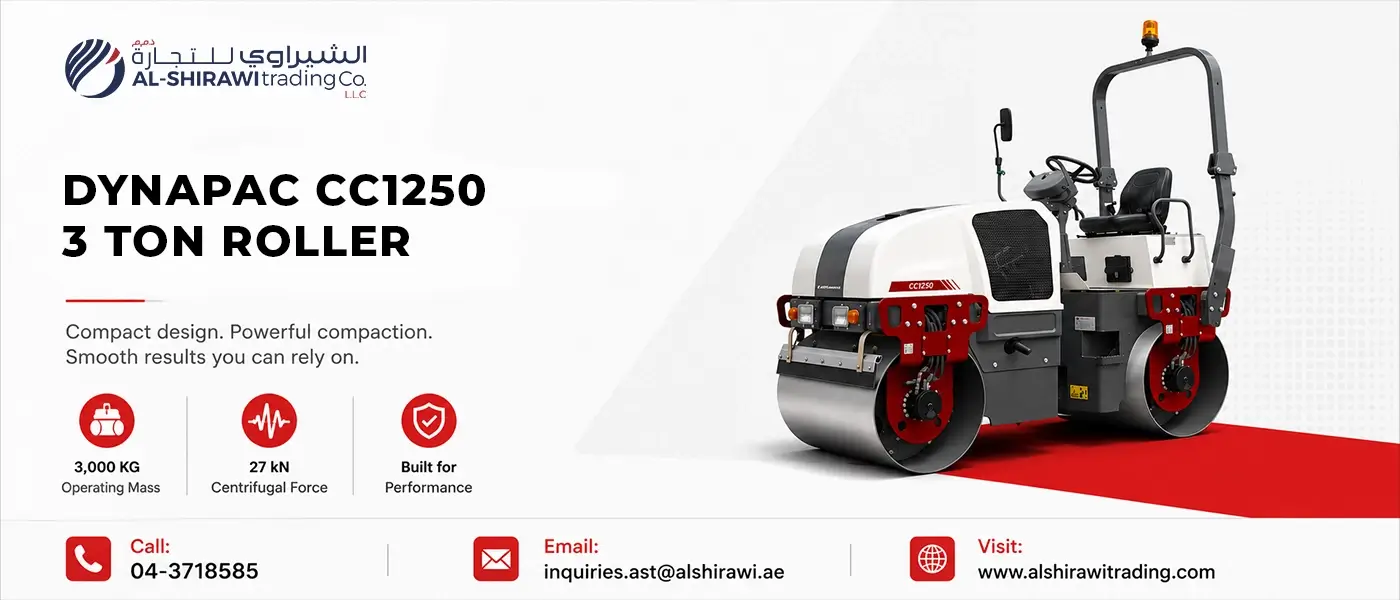
The 3 ton double drum roller category can be attractive to contractors looking for a compact asphalt roller, but machine weight should not be the only consideration.
Before choosing a roller, consider:
- The type of asphalt or material being compacted
- Required density
- Paving width
- Layer thickness
- Available working space
- Expected production rate
- Required vibration characteristics
- Local service and parts support
For asphalt finishing, a tandem roller can be a better fit than a single-drum soil compactor. Single-drum machines are commonly used for soil and sub-base applications, while double drum rollers are widely used for asphalt compaction and finishing.
This distinction is important when comparing equipment advertised simply as a compactor, roller compactor or road roller.
Where does the CC1250 make sense?
The Dynapac CC1250 is particularly worth considering for applications where compact asphalt equipment and manoeuvrability are priorities.
Potential applications include:
- Urban road construction
- City streets
- Parking areas
- Industrial access roads
- Smaller infrastructure projects
- Asphalt repair and resurfacing
- Finishing work in restricted areas
Dynapac positions the CC1250 as a compact tandem roller for city streets, where machine size and noise can be important considerations.
For very large highway projects, heavy-duty earthworks or applications requiring significantly higher production capacity, another Dynapac model may be more appropriate.
The right machine should always be selected according to the project, not simply because it is the cheapest double drum roller for sale.
Don't overlook after-sales support
The purchase price of a road roller is only one part of its cost.
Equipment downtime can affect paving schedules, labour costs and project deadlines. That makes local service capability and spare-parts availability important when selecting construction equipment.
Al Shirawi Trading is the authorised Dynapac dealer in the UAE, supplying Dynapac Road Compaction Equipment along with genuine OEM spare parts and after-sales support.
Its support services include scheduled servicing, preventive maintenance, on-site repair and breakdown assistance.
For contractors, access to genuine spare parts can help keep equipment maintained according to the manufacturer’s requirements and reduce the risk of unnecessary downtime.
Local expertise also matters when selecting equipment. The ideal roller for a compact urban resurfacing project may not be the right choice for a major highway or heavy earthworks application.
What about road roller price?
Searching for road roller price can be a useful starting point, but it should not be the final purchasing criterion.
The actual cost of a double drum roller can vary according to:
- Model and configuration
- Machine specifications
- Optional equipment
- Availability
- Delivery requirements
- Service arrangements
- Parts and maintenance support
A lower initial purchase price may not represent the lowest overall cost if the machine is poorly matched to the application or difficult to maintain.
Instead, contractors should compare the machine’s suitability, expected productivity, support and total cost of ownership.
A simple decision checklist
Before choosing a double drum roller for an asphalt project, ask:
- What material am I compacting?
- What density and surface finish are required?
- What is the available paving width?
- How much manoeuvrability does the site require?
- What operating weight and vibration characteristics are appropriate?
- Can the machine be supported locally with genuine parts and trained service technicians?
If the answers point toward a compact tandem roller for controlled asphalt finishing, the Dynapac CC1250 deserves consideration.
Finish with control, not simply more passes
A high-quality asphalt surface depends on the entire paving process, from mix temperature and placement through to the final rolling pattern.
The Dynapac Double Drum Roller CC1250 provides a compact solution for asphalt compaction, combining a 3,000 kg operating mass, 1,200 mm compaction width and vibratory tandem-roller configuration.
Its compact dimensions can make it particularly useful on urban and restricted sites, while proper operating technique remains essential for achieving the required density and surface finish.
For UAE contractors, equipment selection should also include the support available after the machine arrives on site.
Looking for Dynapac road compaction equipment in the UAE?
Al Shirawi Trading is the authorised Dynapac dealer in the UAE, supplying Dynapac double drum rollers, compactors, road rollers and other road construction equipment, supported by genuine spare parts and local after-sales service.
For help selecting the right Dynapac machine for your asphalt compaction requirements, contact Al Shirawi Trading:
Contact Al Shirawi Trading
Frequently Asked Questions
-
What is a Dynapac Double Drum Roller used for?
A Dynapac double drum roller is primarily used for asphalt compaction and finishing. Its tandem-drum configuration provides consistent contact with the asphalt surface while vibratory action helps achieve the required compaction.
-
Is the Dynapac CC1250 a 3 ton double drum roller?
Yes. The CC1250 has an operating mass of 3,000 kg and a maximum operating mass of 3,100 kg, with a 1,200 mm compaction width.
-
What is the difference between a single drum and double drum roller?
Single drum rollers are commonly used for soil, sub-base and earthwork compaction. Double drum rollers are generally associated with asphalt compaction and finishing, where consistent drum contact and surface quality are important.
-
How much does a double drum roller cost in the UAE?
There is no single road roller price because cost varies according to the model, configuration, availability and support requirements. A project-specific quotation gives a more useful comparison than a generic advertised price.
-
Is the Dynapac CC1250 suitable for city roads?
Yes. Its compact dimensions and tandem configuration make it suitable for applications such as urban roads, city streets, parking areas and other asphalt projects where manoeuvrability is important.
 WhatsApp